
In 90 days on LinkedIn, 55 architects and architectural technologists replied to a luxury steel door maker from London. Thirty-one said something of substance. Four raised live or named projects, one visited the showroom and said she would be happy to specify the products, and one arrived with a live project and a window package he valued in six figures. Below are their own messages, as screenshots.
What happened in 90 days?
The maker already had the product. What it lacked was a way to be known by architects who had never dealt with it. Between 6 July and 3 October 2026 we ran a simple system on LinkedIn: connect with the right architects, say something useful once, keep showing the work, and answer properly.
~440
opening messages sent to architects and specifiers
55
architects and architectural technologists replied
31
replies with substance: questions, requests, projects, meetings, referrals
4
architects raised a live or named project
2
visited the showroom or booked a call
1
live project with a stated six-figure window package
This page is an account of what those architects then said and did. Their messages are shown as screenshots taken from the maker's inbox on 3 October 2026. Black bars cover names, firms, email addresses and locations, and profile photos are blurred. Every word is left as written, typos included. The maker is anonymous at their request.
Why 90 days. In this trade an architect can find a maker today and specify it a year from now, so 90 days is the start of the pipeline, not the end. What 90 days shows is whether the right people noticed, and whether any of them moved. They did.
What was the problem?
The maker designs, manufactures and installs bespoke steel doors, windows and glazed screens, including fire-rated and thermally broken systems. It has a showroom in London and around ten years of completed projects. The work is expensive, made to order and visually distinctive.
Products like this are rarely bought on impulse. They enter a project because an architect or designer draws them in, names them in a schedule or tells a client where to look. Growth depends on a fairly small number of people who each influence many projects.
Architects who had dealt with the maker spoke well of it. Most architects had never dealt with it and had no reason to know it existed. One of them described the gap in her own words during the 90 days:
"Elegant steal doors are hard to come by."
Senior architect and associate, 21 August, replying to the maker's first message
More followers would not fix this. The aim was to be known and remembered by the right architects before their next suitable project arrived. That matters more in bespoke manufacturing than almost anywhere else: in an NBS survey of more than 500 UK specifiers, 78% said the relationship with, and previous experience of, the manufacturer is a factor in what they specify. A maker inside that circle keeps getting specified. A maker outside it can make a better product and still never be considered.
What did we do?
Everything ran through the owner's profile, not a company page, because an architect with a technical question wants a person who can answer it.
- Connect with the right people. Connection requests went to UK architects, architectural technologists and designers who work on the kind of projects that use steel glazing. Nobody else was chased. The whole exercise depends on this list being right.
- Say one useful thing. Every new connection got one short note. It makes no pitch and asks for nothing. It gives an architect a reason to remember the maker and a reason to come back.
- Reopen old connections. Architects who had been connected for years without a word were contacted in the same way.
- Show the work, every week. Regular posts about details, systems and finished projects, written for architects first.
- Comment where architects already are. Thoughtful comments on architects' own posts. One conversation below started with a comment on an architect's post, and another with an architect commenting on the maker's.
- Answer properly, and invite them in. Questions were answered specifically. Where it made sense there was an invitation to the showroom, because the product is more convincing in person than in a photograph.
There were no adverts and no sales pitch in the first message. The wording, the targeting and the timing are the part we do for the maker. How the service works.
Architects noticed
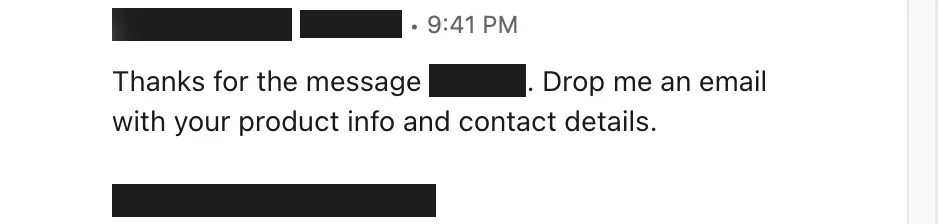
The first step is not a sale. It is an architect who now knows the maker exists, and says so.
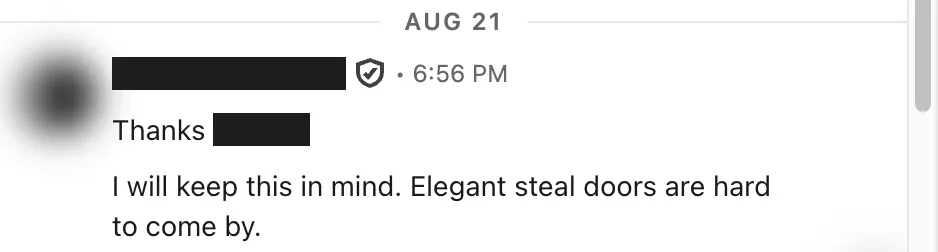
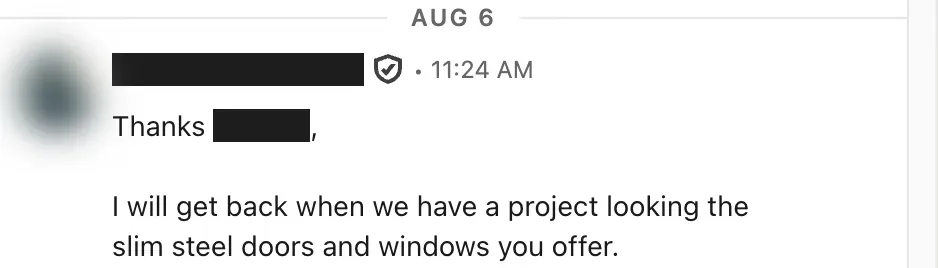
That second message is the long buying cycle stated by the buyer himself. It is the first step every later order depends on.
Architects asked for more
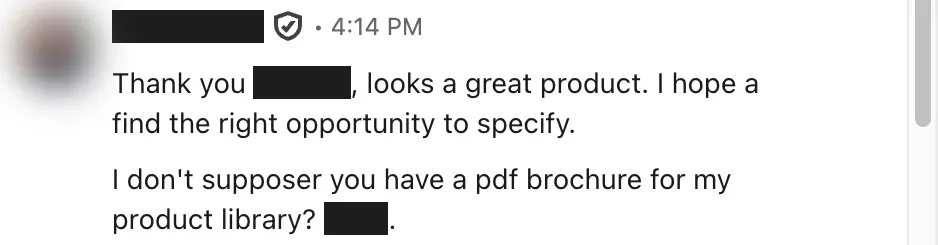
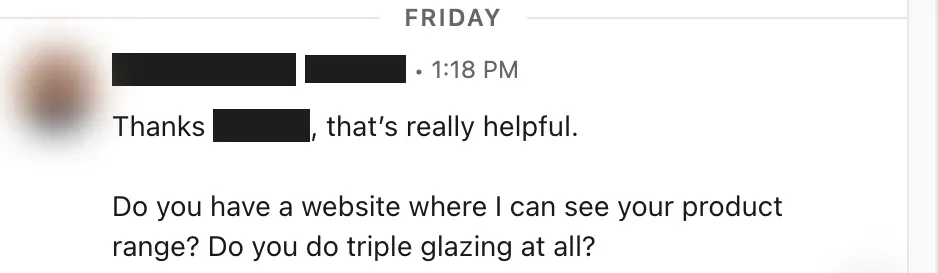
A product library is where an architect looks when writing a specification. Being in it is worth more than being seen in a feed.
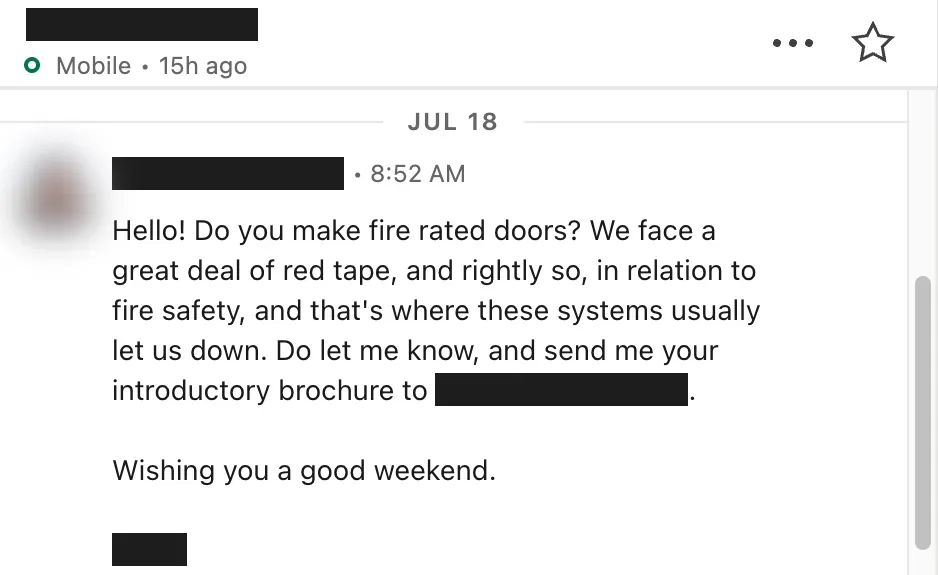
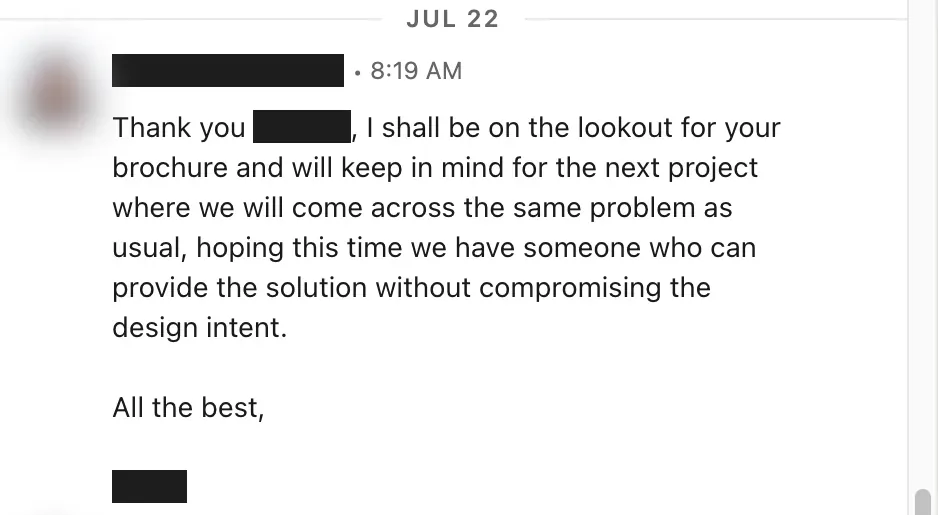
A senior architect named a recurring technical problem and placed the maker as a possible answer to it. The problem repeats across his projects, so the opening does too.
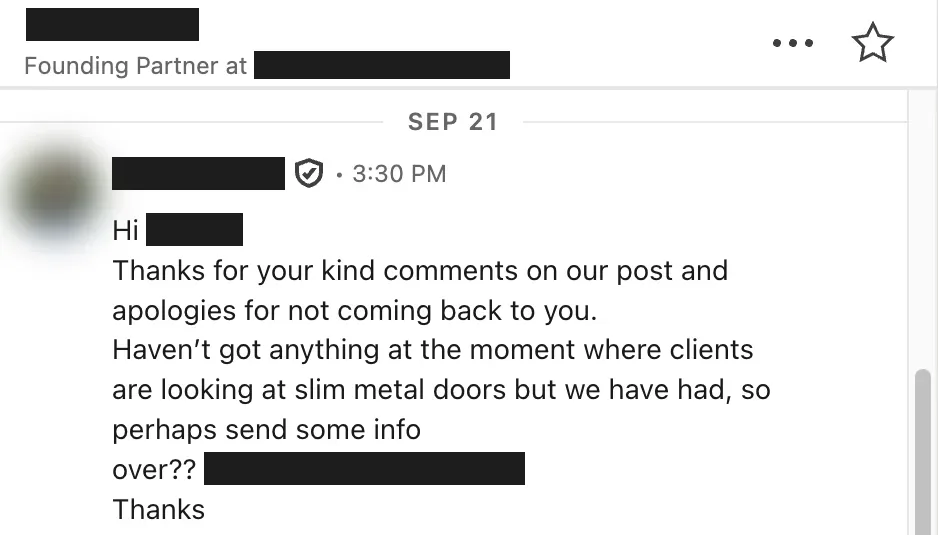
Architects raised live projects
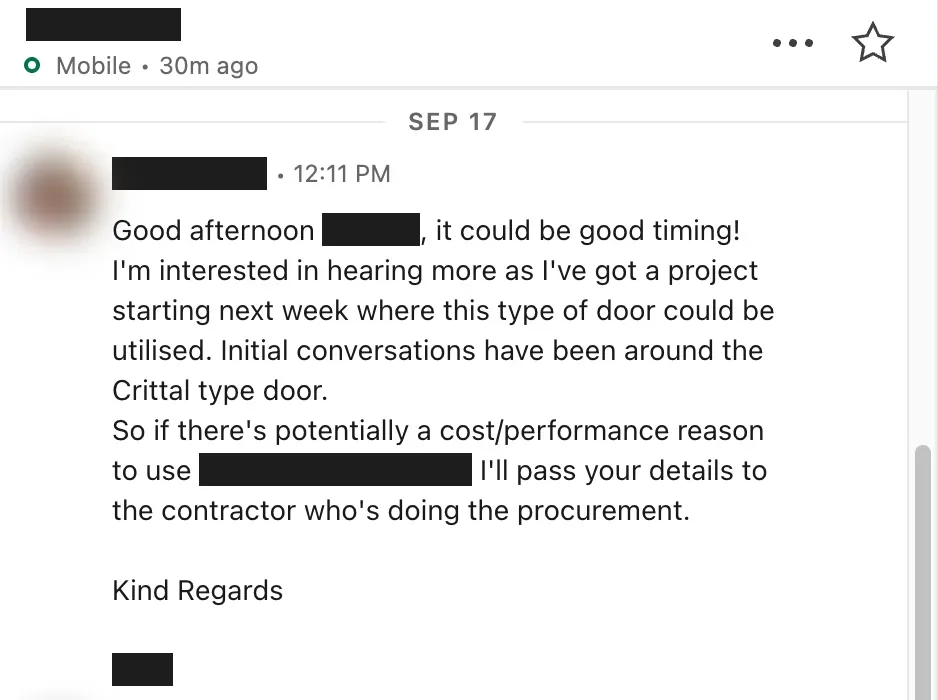
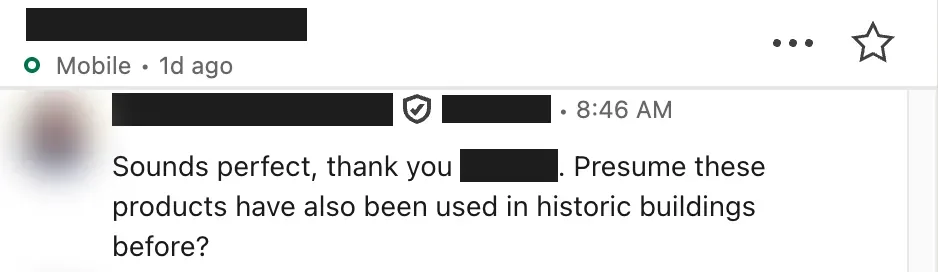
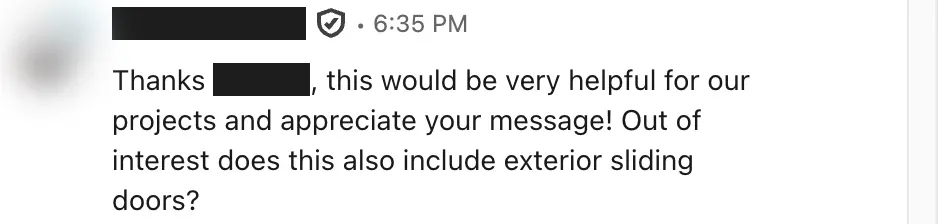
This type of door was already being discussed on that project, and the maker was not part of the discussion until this message.
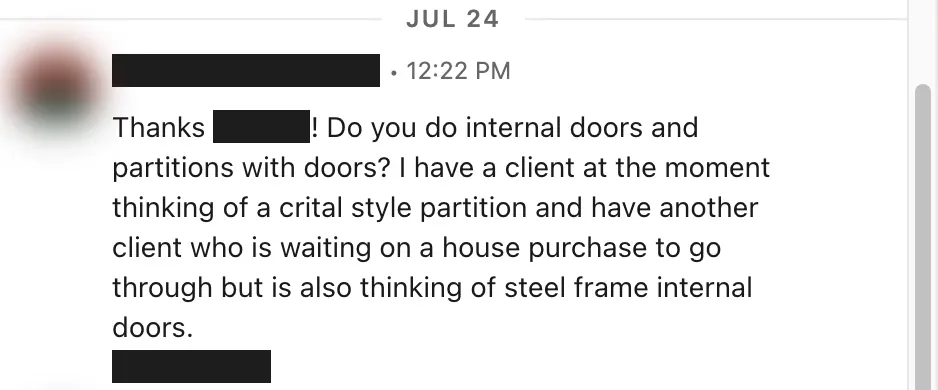
Two client situations in one message. Small practices bring repeat work of exactly this size. The conversation moved to email.
Architects wanted to meet
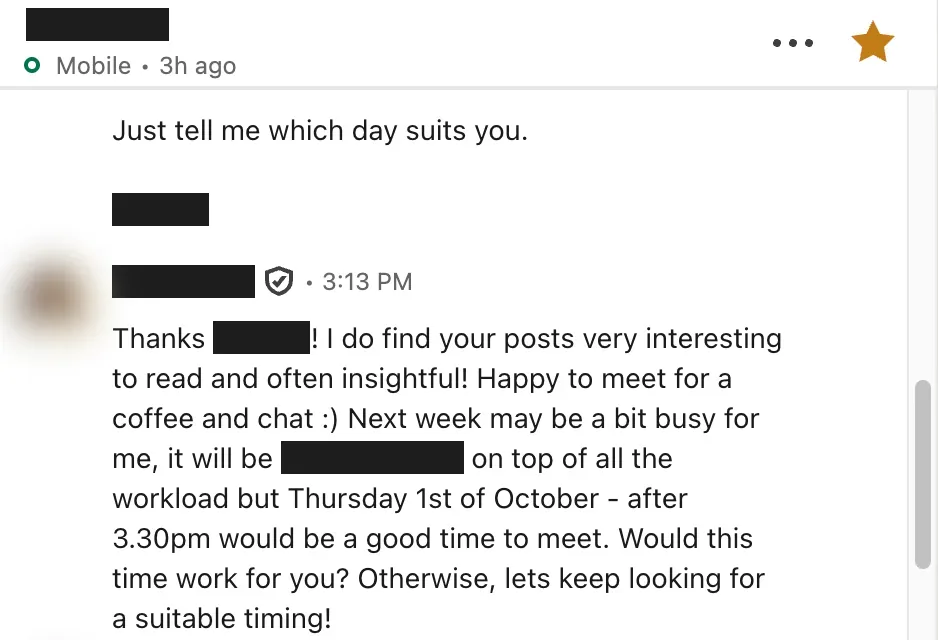
She visited the showroom on 1 October. The next day she wrote again.
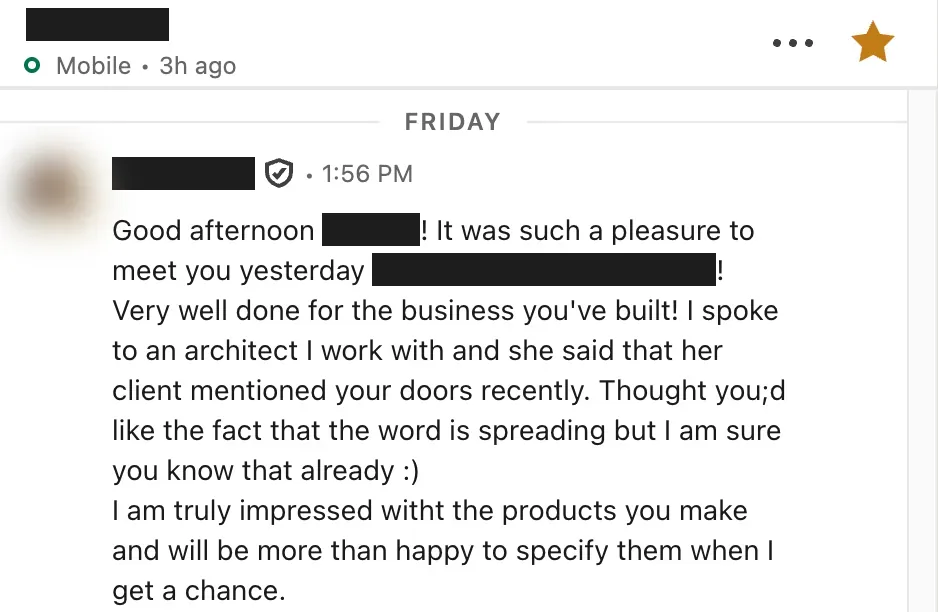
That is the whole path in one conversation: content, comments, a meeting, a showroom visit and a stated intention to specify. An architect who has stood in the showroom and handled the product is a different kind of contact from one who has seen a photograph.
A second architect, RIBA chartered and based in the South West, wrote on 14 September after looking at the website. Her message was not in English, so it is not shown here. Translated: "I am really impressed. Great projects and what achievements! We must arrange a chat. I think my clients will certainly be interested in your offer." A call is booked for 22 October.
Architects recommended the maker
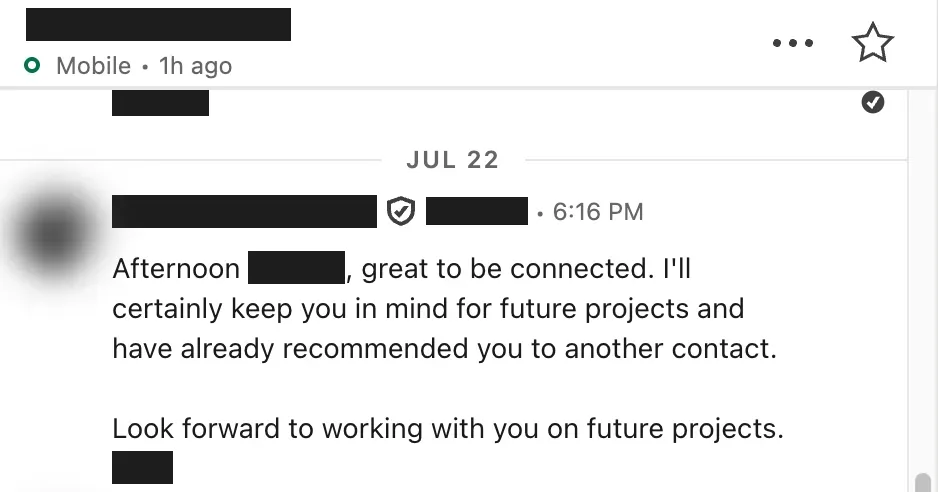
He put his own name behind the maker on the strength of the product and one exchange, inside the first three weeks. Another architect wrote in September: "I will send my colleagues a link to your website."
More of the same, briefly
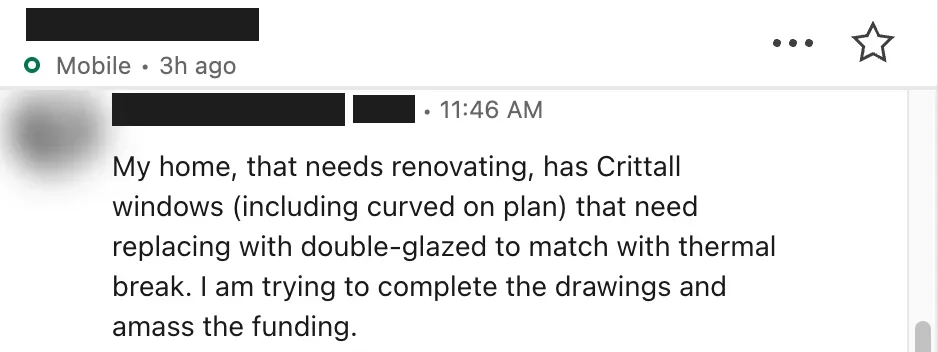

The six-figure conversation
On 30 September, 12 weeks in, a chartered architect who had just connected with the maker wrote about a live project.
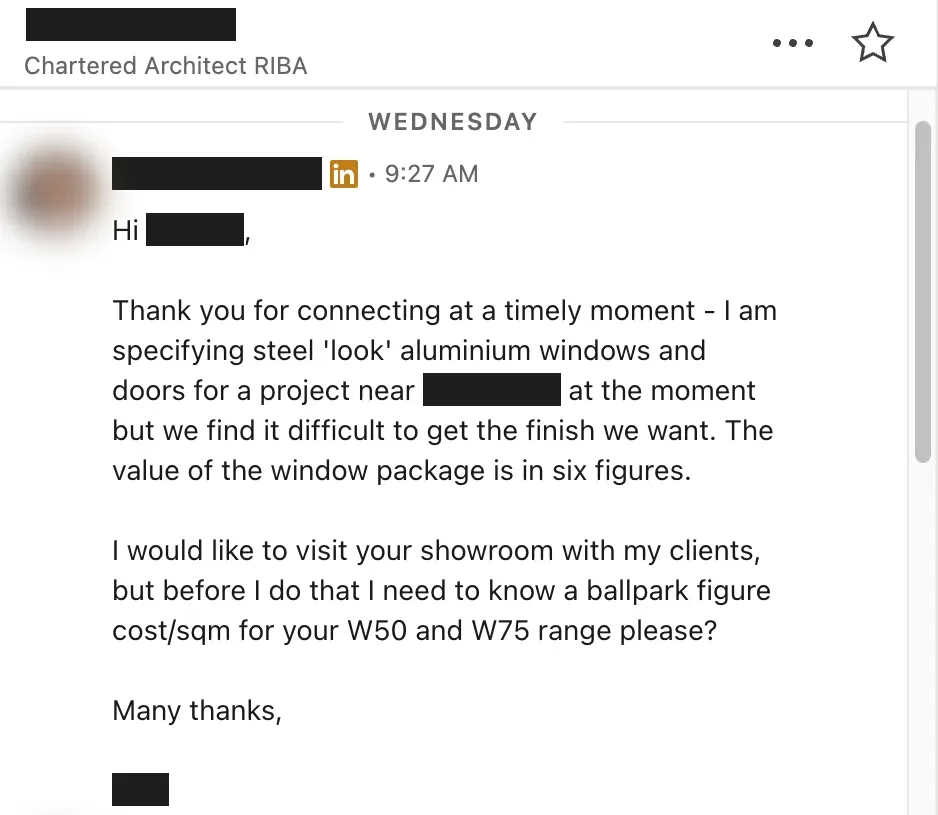
Read it closely, because each part says something different.
- "at a timely moment". The connection was made while the decision was still open. That is what happens when enough of the right architects are contacted.
- "we find it difficult to get the finish we want". He has a problem with the current route, which is aluminium made to look like steel. The maker sells the real thing.
- "in six figures". His number, volunteered in the first message. Nobody asked.
- "visit your showroom with my clients". He is prepared to put the maker in front of the people paying.
- "W50 and W75". He had already looked at the range closely enough to name two systems.
Between his two messages the maker declined to quote a price per square metre blind. It asked for the elevations and the window and door schedule so a realistic budget could be given, and offered the showroom visit once the right system was clear.
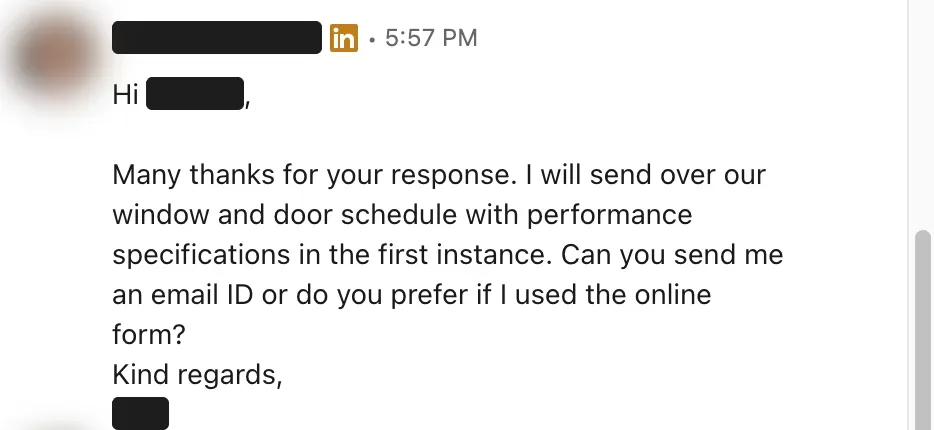
It is still the clearest answer to the question a maker would ask about this whole exercise: do architects with real money to place ever come out of it? On the evidence of these 90 days, one did.
Timeline
| Date | What happened |
|---|---|
| 16 July | The first opening messages go out. An architect replies the same day asking for product information |
| 18 July | A Director of Architecture asks about fire-rated doors and requests the brochure |
| 22 July | An architectural technologist says he has already recommended the maker to a contact |
| 24 July | An architect raises two clients considering steel partitions and doors |
| 10 August | An architect asks for a brochure for his product library |
| 14 September | An architect agrees to meet. A second architect proposes a call about her clients |
| 17 September | An architect with a project starting the following week offers to pass details to the contractor |
| 30 September | An architect brings a live project with a six-figure window package |
| 1 October | The first architect visits the showroom |
| 2 October | She writes that she will be happy to specify the products |
The two strongest enquiries came in the last three weeks.
The supporting numbers
Reach explains how the conversations became possible. It is not the result. These are the maker's own LinkedIn analytics for 6 July to 3 October 2026.
24,988
members reached: people who saw the work at least once
59,158
impressions
72%
out-of-network: most people who saw the posts were not already connected
829
new followers, to a total of 5,220
There were 912 reactions and 172 comments. The connection requests were aimed at architects and designers, and the content was written for them first. The showroom visit came from an architect who was reading and commenting on the posts.
Why 90 days is early
A bespoke steel package enters a project at design stage and is ordered much later, after planning, detailed design, tender and the contractor's own procurement. An architect who files a brochure in August may not have a suitable project until next spring. The messages say so directly.
A name on a drawing is not safe on its own, either. In a 2019 Construction Products Association survey of 524 people across the industry, 39% said they had often seen a product substituted into or out of a specification, and 77% gave a cheaper alternative as the reason. An architect who knows the maker and has seen the product in person is the best defence against being swapped out.
So the first 90 days are not for producing finished orders. They are for the steps that have to come first: being seen by the right architects, being remembered, being asked a question, being visited. Those steps happened here, and they are dated. The next 6 to 12 months are when conversations like these become quotations, specifications and orders.
Who this is not for
- Businesses for whom the sums do not work. This takes months of steady work before the first order. It makes sense where one good architect relationship is worth many times the cost of creating it.
- Owners who are not proud of the product. This can win attention. It cannot make the product better.
- Businesses that need orders this month. The six-figure enquiry arrived 12 weeks in, and the order comes later still.
- Makers who will not show their work. There has to be something to put in front of an architect.
Questions about this case study
Are these real messages?
Yes. They are screenshots from the maker's LinkedIn inbox, taken on 3 October 2026. Names, firms, email addresses and locations are covered with black bars and profile photos are blurred. Nothing else is changed.
Why is the maker not named?
The maker asked to stay anonymous in the case study. The architects are not named either, because they wrote to the maker, not to the public.
Did any of this turn into orders?
Not within the 90 days, and that is normal for this trade. An architect with a live six-figure project asked for pricing and agreed to send the schedule, and another said she will be happy to specify the products. Orders follow the project timetable, usually months later.
How many messages were sent?
About 440 opening messages over the 90 days, to architects, architectural technologists and designers chosen by the kind of projects they work on.
Can you do the same for my business?
Only if your category is open and the sums work for your business. Steel doors and windows is taken. See the open categories, or book a call and we will go through how the first 90 days would look for you.
Make something architects should specify?
We can go through how the first 90 days would look for your business: who we would contact, what we would say and what you would need to bring.
Sources
- NBS, What Specifiers Want (UK, more than 500 responses): thenbs.com
- AIA with B2B International, The Truth About Specification (US, 2016, 330 architects), reported by Architect magazine
- Construction Products Association survey (UK, 2019, 524 responses), reported by Construction Management
- LinkedIn figures are from the maker's own analytics for 6 July to 3 October 2026.